
Product research and financial education from the PopaDex team.
Published · Updated
Expat Financial Planning: 12 Steps for Managing Money Abroad
Expat financial planning starts with one reliable inventory: what you own, what you owe, where each account is held, which currency it uses, and which country can tax or regulate it. Once that map exists, you can build the rest of the plan around cash flow, banking, tax, insurance, pensions, investments, and estate documents.
The order matters. Choosing investments before confirming residency, account access, and tax treatment can create expensive cleanup. A better sequence is to establish the facts, protect near-term cash, identify professional questions, and only then optimize.
This guide provides general financial education, not individualized tax, legal, or investment advice. Cross-border rules depend on citizenship, residence, domicile, account type, and the countries involved. Use a qualified professional for decisions with legal or tax consequences.
Expat financial dashboard
See your accounts and net worth in one reporting currency
PopaDex helps internationally mobile households organize assets and liabilities across countries and currencies. Add accounts manually for free or use compatible connections where available.
The 12-Step Expat Financial Planning Checklist
Use this as a working sequence, not a one-time reading list.
| Step | Action | Evidence to keep |
|---|---|---|
| 1 | Record citizenship, residence, domicile, and move dates | Passports, visas, leases, travel log |
| 2 | Inventory every account, asset, debt, and policy | Institution, country, owner, currency, balance |
| 3 | Choose a household reporting currency | Written rule and exchange-rate source |
| 4 | Build a relocation and monthly cash-flow plan | Income, fixed costs, transfers, one-off move costs |
| 5 | Separate emergency cash from planned spending | Target amount and accessible account locations |
| 6 | Review bank and brokerage availability after the move | Written institution confirmations and fee schedules |
| 7 | Map tax filing and reporting obligations | Adviser notes, deadlines, forms, source documents |
| 8 | Review pensions and social-insurance rights | Statements, contribution records, beneficiary details |
| 9 | Check health, life, disability, property, and liability cover | Policies, exclusions, territories, renewal dates |
| 10 | Review investments for tax, currency, and access constraints | Fund domicile, account wrapper, fees, restrictions |
| 11 | Update wills, powers of attorney, and beneficiaries | Signed documents and country-specific advice |
| 12 | Set monthly, quarterly, and annual review dates | Calendar reminders and named owners |
1. Map Residency Before Making Financial Changes
Write down the dates you left one country, entered another, started work, established a home, and changed employment. Those dates can affect tax residence, payroll, social insurance, account eligibility, and reporting.
Do not assume that a visa, citizenship, tax residence, and domicile mean the same thing. They can be different concepts with different tests. For a move involving two tax systems, create a one-page residency timeline and ask a qualified cross-border tax professional to confirm the treatment before selling investments, exercising equity, moving a pension, or changing ownership structures.
For US citizens and resident aliens, the IRS states that worldwide income generally remains reportable while living abroad, although qualifying individuals may be eligible for the foreign earned income exclusion or foreign tax credit. The rules and limits change, so use the current IRS international taxpayer guidance rather than an old article or a remembered threshold.
2. Build a Cross-Border Financial Inventory
A useful inventory has one row for every item:
| Field | Example |
|---|---|
| Account or asset | Workplace pension |
| Institution | Provider name |
| Country | Country where held |
| Legal owner | You, partner, joint, company, trust |
| Native currency | Currency shown on the statement |
| Current balance | Balance in native currency |
| Reporting value | Converted household value |
| Access status | Active, restricted, frozen, closing |
| Tax or reporting note | Question to confirm with an adviser |
| Beneficiary or contact | Named person and last review date |
Include bank and brokerage accounts, pensions, property, private-company interests, vehicles, valuable collections, credit cards, mortgages, student loans, and personal loans. Record ownership explicitly; a joint household view should not erase who legally owns each item.
This inventory is the basis of a multi-currency net worth tracker and the handoff document for an accountant or adviser.
3. Choose One Reporting Currency Without Hiding Native Balances
Choose the currency that best matches your current decision-making—often the currency in which you spend, plan retirement, or discuss household goals. Then preserve the native balance beside the converted value.
A sound method is:
- Keep the original amount and currency for every account.
- Choose one documented exchange-rate source.
- Use the same valuation time for a monthly snapshot.
- Separate contributions and withdrawals from exchange-rate movements.
- Review major goals in the currency in which the cost will occur.
This avoids a common mistake: seeing net worth rise in the reporting currency and assuming the investments performed well when most of the change came from foreign exchange.
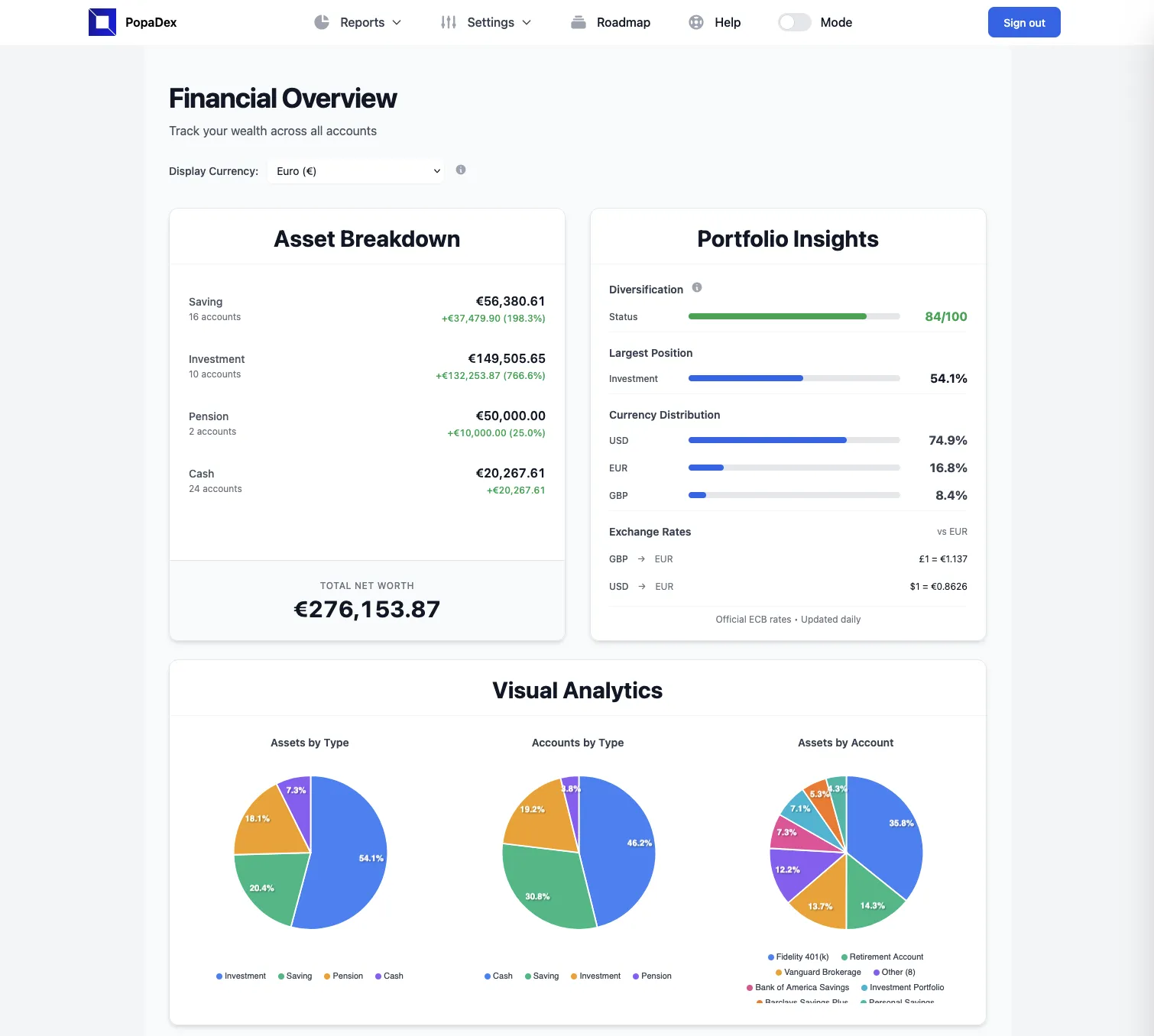
PopaDex can consolidate manually entered and compatible connected accounts into one household reporting view. The screenshot contains sample data; available connections vary by institution and country.
4. Plan Cash Flow for the Move and the First Year
Build two budgets:
- A relocation budget for deposits, temporary housing, travel, visas, shipping, furniture, professional fees, and duplicate costs.
- A steady-state budget for housing, utilities, insurance, childcare, transport, tax reserves, travel home, currency conversion, and long-term saving.
Keep one-off move costs out of the normal monthly budget. Otherwise, the first year can look permanently unaffordable even when the ongoing plan is sound.
If income and spending use different currencies, model a conservative exchange rate as well as the current rate. The goal is not to forecast currency markets. It is to know whether a reasonable adverse move would threaten rent, tax payments, or near-term goals.
Use the international salary calculator to compare offers, but verify local payroll deductions and benefits before accepting a role.
5. Hold Emergency Cash Where You Can Actually Reach It
An emergency fund is less useful if it sits behind a bank login you lose after moving or in a currency that cannot cover local expenses quickly.
Decide:
- how many months of essential costs you want available;
- which portion must be in the local spending currency;
- which account can be accessed without a local phone number or address;
- who can access funds if you are incapacitated;
- whether deposit protection applies to the institution and account type.
Also keep a separate reserve for known annual obligations such as insurance renewals, school fees, professional filings, and trips home.
6. Confirm Banking and Brokerage Access in Writing
Before changing address, ask each institution whether it can serve residents of the destination country. Confirm what happens to trading, deposits, withdrawals, statements, tax documents, multi-factor authentication, and joint access.
Compare the full transfer cost: fixed fee, exchange-rate spread, receiving fee, weekend markup, and intermediary-bank charges. A service advertised as “free” can still be expensive through its exchange rate.
Do not close every home-country account automatically. First check whether keeping an account is permitted and useful for bills, refunds, credit history, pension payments, or a future return. Equally, do not keep an account by concealing your new address or residence.
7. Create a Tax and Reporting Calendar
Your plan should identify the countries that may require a return, the deadlines, the professional responsible, and the documents needed. Common topics include employment income, self-employment, rental property, investments, pensions, equity compensation, foreign accounts, and wealth or estate taxes.
US persons may also have foreign-account reporting obligations. FinCEN says an FBAR is required when a US person’s aggregate foreign financial accounts exceed $10,000 at any point in the calendar year, subject to the detailed rules and definitions. Check the current FinCEN FBAR guidance and professional advice; do not rely on a net-worth app to determine filing obligations.
Keep tax records separate from the financial dashboard. PopaDex can organize balances and ownership context, but it does not calculate cross-border tax liability or file returns.
8. Trace Pensions and Social-Insurance Rights
List every state, workplace, and private pension in each country. Record service periods, contribution history, vesting, access age, beneficiary, currency, and the authority or provider that holds the record.
Do not transfer a pension solely to simplify the dashboard. Transfers can affect tax treatment, guarantees, investment options, fees, and future benefits. Within the EU, national systems generally calculate pension entitlements using the insurance record in each country; the European Commission’s pension guidance explains the coordination framework. Other country pairs may have different agreements.
9. Review Insurance by Territory, Not Just Policy Name
Check where each policy applies and what changes after residency or employment changes. Review:
- health insurance and evacuation cover;
- life and disability insurance;
- renters or homeowners cover;
- vehicle insurance;
- professional and personal liability;
- travel duration limits;
- exclusions for work, sport, or pre-existing conditions.
Get written confirmation when coverage is material. A policy that remains active may still exclude claims arising in the new country.
10. Review Investments for Access, Tax, and Currency
Start with constraints before selecting funds:
- Can the institution legally serve you after the move?
- How is the account wrapper treated in both countries?
- Does the fund’s domicile create additional reporting or tax complexity?
- Which currency will fund the future goal?
- Are fees, withholding taxes, and transfer costs understood?
- Can your partner or executor access the records?
Diversification is not the same as holding accounts in many countries. Too many platforms can increase fees, paperwork, and estate complexity without reducing investment risk.
11. Update Estate Documents and Beneficiaries
Review wills, powers of attorney, guardianship wishes, beneficiary nominations, account ownership, and digital-access instructions. Ask a qualified professional whether documents from one jurisdiction will work in another and whether local succession rules affect your plan.
Keep a secure inventory showing where signed originals are stored and whom to contact. Do not put passwords or recovery codes in the same document.
12. Run a Repeatable Review Cycle
Use three review levels:
- Monthly: update balances, reconcile large transfers, review cash reserves, and record net worth.
- Quarterly: review currency exposure, goal progress, upcoming taxes, insurance renewals, and account-access changes.
- Event-driven or annual: revisit residency, tax, pensions, investments, and estate planning after a move, marriage, birth, property purchase, business launch, or job change.
The review should end with named actions, owners, and dates—not just a new dashboard number.
When an Expat Finance App Helps
An app is useful for organization and monitoring. It cannot decide residency, interpret a treaty, or replace regulated advice.
| Need | Best tool |
|---|---|
| Daily spending and category budgets | Budgeting or expense app |
| International transfers | Regulated bank or transfer provider |
| Tax filing and treaty questions | Qualified cross-border tax professional |
| Portfolio advice | Appropriately licensed adviser |
| Accounts, assets, debts, and net worth across currencies | Multi-currency net worth tracker |
| Shared tasks and document deadlines | Checklist or project tool |
PopaDex is best suited to the consolidated financial-inventory job. It supports manual account entry on the free plan, compatible institution connections on Premium where available, assets and liabilities, household views, and 12+ currencies. It is not an accounting ledger, tax engine, transfer service, or investment adviser.
How to Choose a Cross-Border Adviser
Ask potential advisers:
- Which country pairs and client situations do you work with regularly?
- Which licences and credentials can I verify with the regulator?
- Are you advising on tax, investments, pensions, estate planning, or coordinating specialists?
- How are you paid, including commissions, referral fees, and product charges?
- Who holds the assets and what happens if your firm closes?
- Will you provide recommendations, assumptions, and total fees in writing?
- How will you work with my accountant or lawyer in the other country?
Be cautious with pressure, opaque offshore products, long lock-in periods, guaranteed returns, or advice that depends on hiding your residence from an institution.
Expat Financial Planning FAQ
What should an expat financial plan include?
It should map residence, income, spending, accounts, assets, debts, insurance, pensions, investments, estate documents, and goals across every relevant country and currency. It should also record deadlines and which professional owns each jurisdiction-specific question.
How do expats manage finances in multiple currencies?
Keep native balances, select one reporting currency, use a consistent exchange-rate source, and review both the consolidated total and currency exposure. Separate market performance, contributions, withdrawals, and exchange-rate changes when evaluating progress.
Do expats need a financial adviser?
Not for every task. Specialist advice becomes valuable when residency, pensions, equity compensation, business ownership, estate planning, or investments span jurisdictions. Verify credentials, country experience, fees, custody, and conflicts.
How often should expats review their financial plan?
Review balances monthly, complete a deeper review quarterly, and revisit legal, tax, insurance, pension, and estate assumptions whenever a major life or residency event occurs.
Organize the cross-border picture
Build one view of your international net worth
Use PopaDex to record accounts, assets, and liabilities across currencies, then bring that organized inventory to the specialists who advise on tax, pensions, and investments.